

Introduction
“AC not cooling” is one of the most common service requests across India every summer. With temperatures frequently crossing 40°C in many regions and humidity levels remaining high in coastal cities, air conditioners work harder than ever to maintain indoor comfort. Over time, dust accumulation, refrigerant leaks, electrical issues, and poor maintenance can affect cooling performance.
There is nothing more frustrating than switching on your air conditioner during a hot Indian summer and realizing that it is not cooling properly. The AC may be running, the display may show a low temperature, and the fan may be blowing air, yet the room remains warm and uncomfortable.
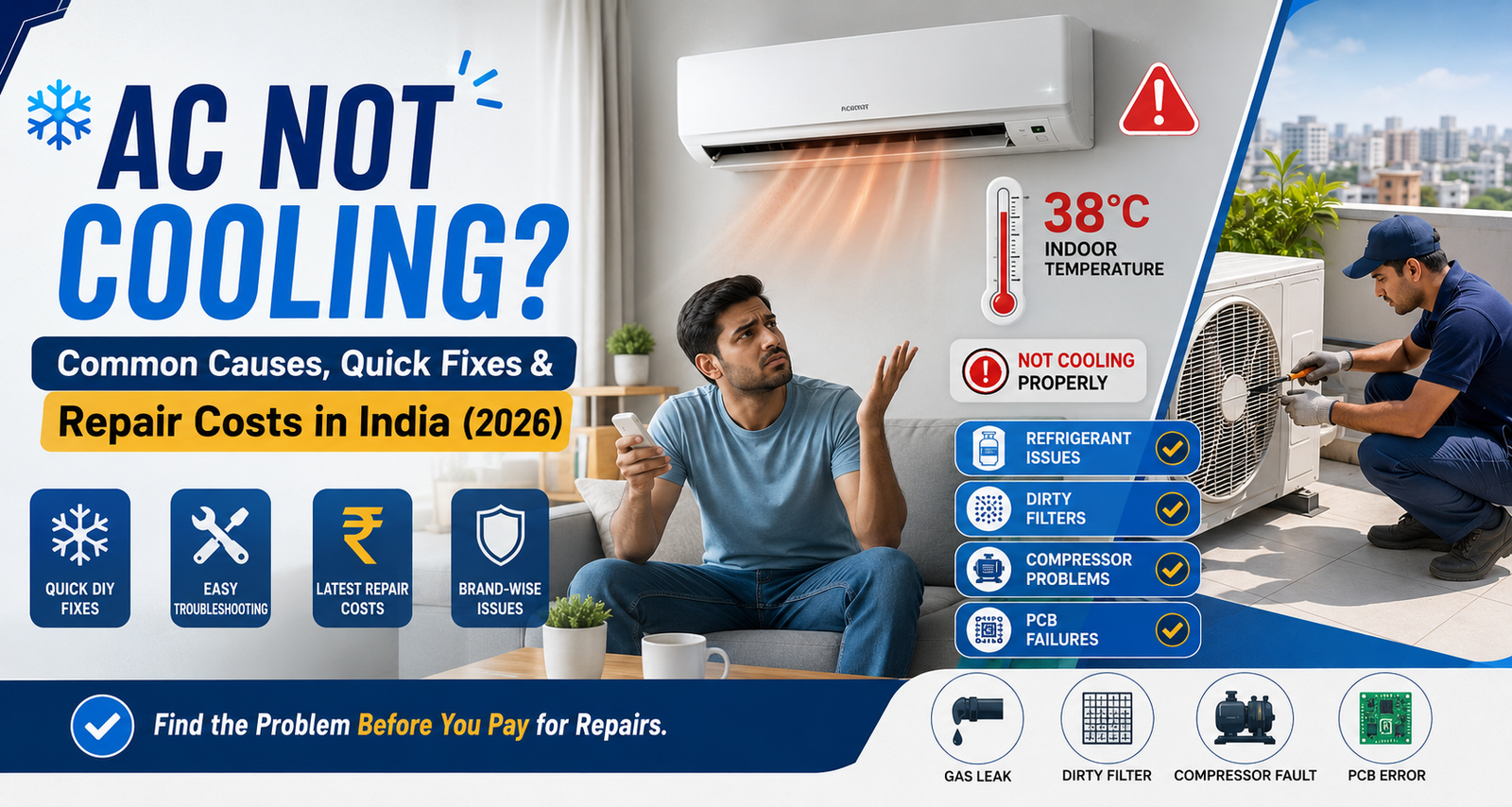
Why AC Cooling Problems Are Common in India
Air conditioners operating in India face unique challenges compared to those in many other countries.
Extreme Summer Temperatures
Most air conditioners are tested under standard operating conditions. However, in many parts of India, outdoor temperatures can exceed 45°C during peak summer. When temperatures rise beyond design conditions, the AC system must work harder to cool indoor spaces.
Dust and Pollution
India’s environment contains high levels of dust, especially in urban and construction-heavy areas. Dust quickly accumulates on filters and condenser coils, reducing airflow and cooling efficiency.
Voltage Fluctuations
Frequent voltage variations can affect AC components such as compressors, capacitors, and PCBs (Printed Circuit Boards). Power surges are one of the leading causes of electrical failures in inverter air conditioners.
High Humidity Levels
Cities such as Chennai, Mumbai, Kochi, and Kolkata experience high humidity throughout the year. Excess moisture forces air conditioners to work harder, increasing wear and tear on the system.
Inadequate Maintenance
Many homeowners use their AC continuously during the summer but neglect regular servicing. Dirty filters and clogged coils are among the most common reasons for reduced cooling performance.
5 Essential Checks Before Calling a Technician
Before spending money on repairs, perform these simple checks.
1. Verify the Cooling Mode
Many users accidentally switch their AC to Fan Mode or Dry Mode.
Check the remote and confirm that:
- Cool Mode (❄️) is selected.
- The temperature is set between 22°C and 24°C.
- Sleep Mode is disabled if maximum cooling is required.
After adjusting the settings, wait at least five minutes to evaluate the cooling performance.
- Replace the Remote Batteries
Weak batteries can cause communication issues between the remote and the indoor unit.
Sometimes the AC receives the power command but does not register temperature or mode changes.
Installing fresh batteries is a simple step that surprisingly resolves many cooling complaints.
- Clean the Air Filters
Air filters trap dust and airborne particles before they enter the AC system.
Over time, these filters become clogged, restricting airflow.
Signs of Dirty Filters
- Weak airflow from the indoor unit
- Longer cooling time
- Increased electricity consumption
- Unpleasant odors
How to Clean the Filters
- Turn off the AC.
- Open the front panel.
- Remove the filters.
- Wash them with clean water.
- Allow them to dry completely.
- Reinstall them.
Cleaning the filters regularly can improve cooling efficiency significantly.
- Reset the AC
Modern inverter ACs contain electronic control systems that occasionally experience software glitches.
Reset Procedure
- Switch off the AC from the main power source.
- Wait for two minutes.
- Turn the power back on.
- Restart the AC.
This process often resolves temporary system errors.
- Check the Outdoor Unit
The outdoor unit is responsible for releasing the heat removed from the room.
If airflow around the outdoor unit is blocked, cooling performance decreases dramatically.
Inspect for:
- Dust buildup
- Plastic covers
- Leaves and debris
- Overgrown plants
- Blocked ventilation space
Ensure at least 30–40 cm of open space around the outdoor unit.
Most Common Reasons Why Your AC Is Not Cooling
1. Low Refrigerant (Gas) Level
Refrigerant is the cooling medium that absorbs heat from indoor air.
If refrigerant levels drop due to leaks, cooling performance declines significantly.
Symptoms
- AC runs continuously
- The room cools very slowly
- Ice forms on copper pipes
- Hissing sounds near the indoor unit
- Increased power consumption
Typical Repair Cost
₹1,500 – ₹3,500
- Dirty Condenser Coils
Condenser coils release heat outside the home.
When covered with dust and dirt, heat transfer becomes inefficient.
Symptoms
- Reduced cooling
- High electricity bills
- The outdoor unit is becoming excessively hot
Service Cost
₹600 – ₹1,200
- Compressor Problems
The compressor is often called the heart of an air conditioner.
Without a functioning compressor, refrigerant cannot circulate effectively.
Symptoms
- AC runs but produces warm air
- The outdoor unit starts and stops frequently
- Unusual humming sounds
Repair Cost
₹6,000 – ₹18,000
Depending on capacity and brand.
- Frozen Evaporator Coil
A frozen coil blocks airflow and prevents proper cooling.
Causes
- Dirty filters
- Low refrigerant
- Restricted airflow
Symptoms
- Ice on copper pipes
- Weak airflow
- Indoor unit becoming unusually cold
Turn off the AC immediately and allow the ice to melt before further diagnosis.
- PCB (Printed Circuit Board) Failure
The PCB controls all major AC operations.
Voltage fluctuations are one of the primary causes of PCB damage in India.
Symptoms
- Error codes
- Compressor not starting
- Temperature settings ignored
- AC turns on but does not cool
Repair Cost
₹1,500 – ₹12,000
depending on the model.
When Should You Stop Troubleshooting?
Call a qualified technician immediately if you notice:
- Ice on refrigerant pipes
- Burning smell
- Hissing gas sounds
- Grinding noises
- Repeated circuit breaker trips
- Continuous water leakage
- Error codes that persist after reset
- The outdoor unit fan is running without compressor operation
Ignoring these symptoms can lead to expensive compressor damage.
Conclusion
An air conditioner that is not cooling does not always require an expensive repair. Many cooling issues are caused by dirty filters, incorrect settings, blocked airflow, or minor maintenance problems. By performing a few simple checks, homeowners can often restore cooling performance without professional assistance.
However, if symptoms such as refrigerant leaks, compressor failures, PCB faults, or electrical issues are present, professional diagnosis becomes necessary. Regular maintenance, proper AC sizing, and timely servicing can significantly extend the lifespan of your air conditioner while keeping electricity costs under control.
FAQ
1. Why is my AC running but not cooling?
The most common reasons are dirty filters, low refrigerant levels, frozen coils, blocked condenser coils, or compressor issues.
2. How often should I service my AC?
At least once a year, preferably before the summer season begins.
3. What is the cost of an AC gas refill in India?
Typically between ₹1,500 and ₹3,500 depending on the refrigerant type and AC capacity.
4. Which AC brand is most reliable in India?
Daikin, O General, LG, and Hitachi are generally considered among the most reliable AC brands.
5. Can low voltage affect AC cooling?
Yes. Frequent voltage fluctuations can damage compressors, capacitors, and PCBs, leading to poor cooling performance.
6. How do I know if my AC has low refrigerant gas?
Signs include weak cooling, ice formation on pipes, hissing sounds, and longer cooling cycles.
7. Is it safe to clean AC filters at home?
Yes. Cleaning the air filter is a simple DIY maintenance task that can improve cooling efficiency.
8. How long does an AC compressor last?
With proper maintenance, an AC compressor can last between 8 and 12 years.
9. Does a dirty outdoor unit affect cooling?
Yes. Dust and debris on condenser coils reduce heat transfer efficiency and cooling performance.
10. When should I replace my AC instead of repairing it?
If the AC is over 10 years old and major repairs cost more than 50% of a new unit’s price, replacement is usually the better option.